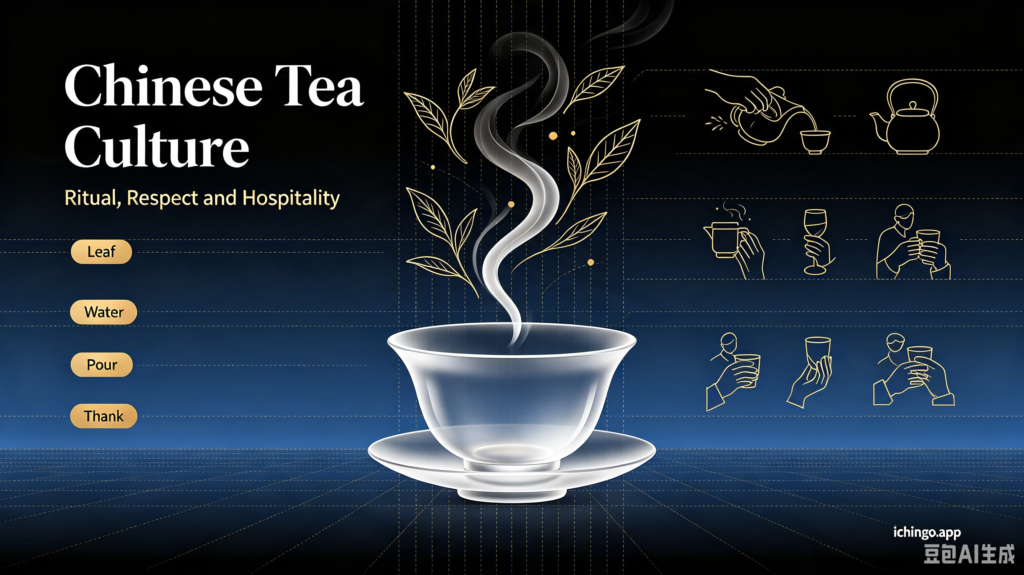
Introduction — Why Tea Is China’s Soul in a Cup
China did not invent tea because it was tasty. According to legend, Emperor Shen Nong discovered it in 2737 BC when leaves fell into his boiling water. For 5,000 years since, tea has been medicine, currency, diplomacy, philosophy, and daily ritual — all at once. Today China produces over 3 million tonnes of tea per year, more than any other country on earth.
For a foreign visitor, understanding Chinese tea culture unlocks something important: the Chinese concept of time. In a country famous for its speed and efficiency, the tea ceremony is deliberately, beautifully slow. It is an invitation to stop, breathe, pay attention, and be present. Accepting that invitation — even once — will change how you see China.
This guide covers the six families of Chinese tea, the art of Gongfu Cha (功夫茶), famous tea-producing regions, where to experience tea culture as a visitor, and which ichingo.app apps will help you find tea houses, book experiences, navigate to tea markets, and pay for everything.
Part 1 — The Six Families of Chinese Tea (六大茶类)
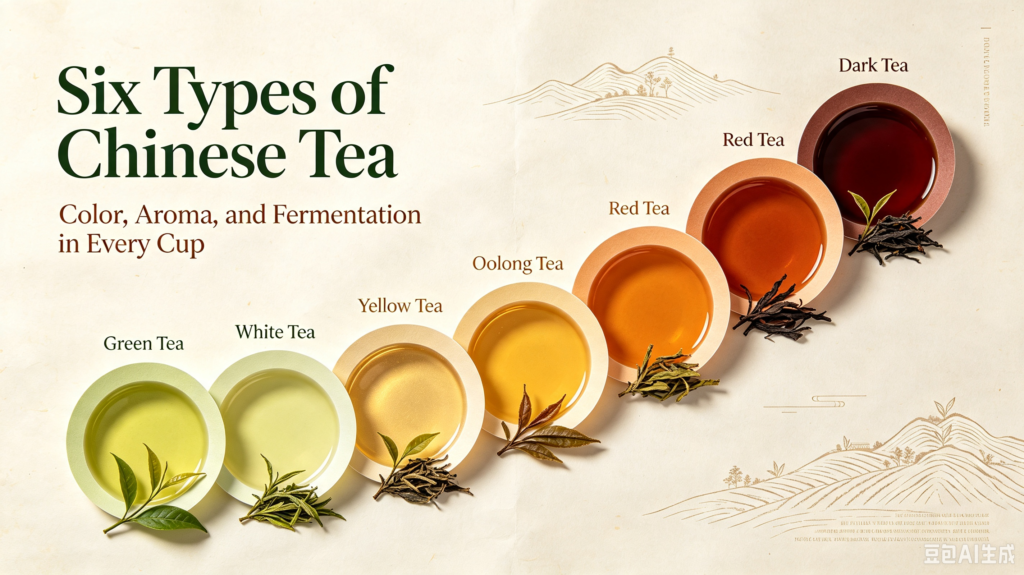
All Chinese tea comes from the same plant: Camellia sinensis. The six tea families are defined entirely by how the leaves are processed after picking — specifically, how much oxidation is allowed. This single variable produces teas so different in taste, color, and effect that they seem to come from entirely different plants.
| Family | Chinese | Oxidation | Color | Famous Varieties | Flavor Profile |
| Green Tea | 绿茶 Lv Cha | None (0%) | Pale green / yellow | Longjing (Dragon Well), Biluochun, Mao Feng | Fresh, grassy, vegetal, light. The most consumed tea in China. |
| White Tea | 白茶 Bai Cha | Minimal (5-10%) | Pale gold | Silver Needle (Baihao Yinzhen), White Peony | Delicate, sweet, subtle. Aged white tea develops deep complexity. |
| Yellow Tea | 黄茶 Huang Cha | Slight (10-20%) | Yellow-gold | Junshan Yinzhen, Mengding Huangya | Rare and precious. Mellow, smooth, slightly sweet. Hard to find outside China. |
| Oolong Tea | 乌龙茶 Wulong Cha | Partial (20-80%) | Gold to amber | Tie Guan Yin, Da Hong Pao, Dong Ding | The most diverse family. Ranges from floral and light to rich and roasted. |
| Black Tea | 红茶 Hong Cha | Full (100%) | Deep red-brown | Keemun (Qimen), Dian Hong, Lapsang Souchong | Bold, malty, warm. Note: Chinese call it ‘Red Tea’ (红茶), not black. |
| Dark / Pu-erh Tea | 黑茶 Hei Cha | Post-fermented | Dark brown/black | Pu-erh (Yunnan), Liu Bao (Guangxi) | Earthy, woody, deep. Aged versions are collector’s items worth thousands. |
| 📌 Did You Know: When Westerners say ‘black tea’, Chinese people say ‘red tea’ (红茶 hong cha) — because the brewed liquid is red, not black. What China calls ‘black tea’ (黑茶 hei cha) refers to post-fermented teas like Pu-erh. This causes enormous confusion in tea shops — if you ask for ‘black tea’ in China, always clarify which type you mean. |
The Most Famous Teas Every Visitor Should Know
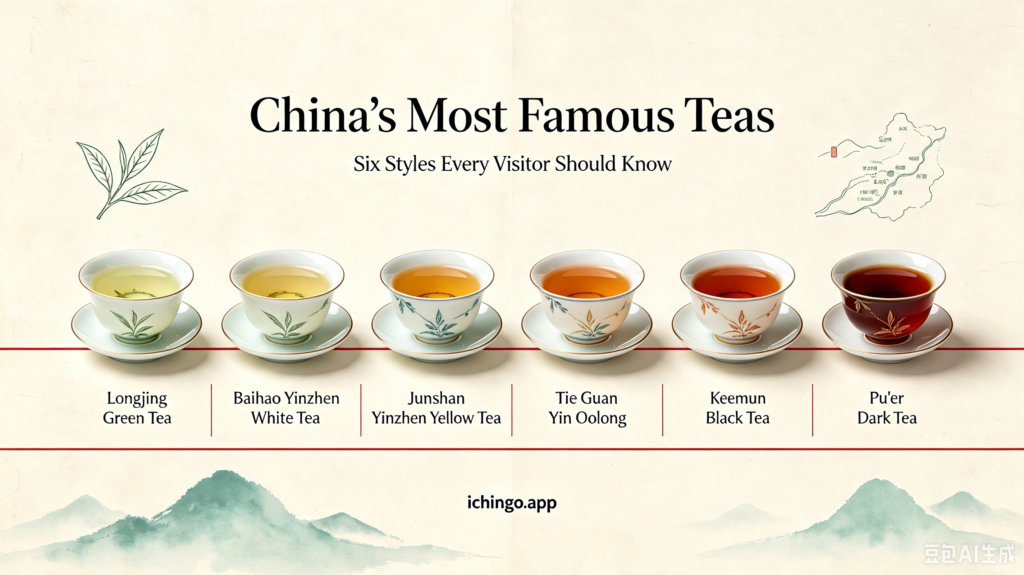
| Tea | Chinese | Region | Why It Is Famous |
| Longjing (Dragon Well) | 龙井 | Hangzhou, Zhejiang | China’s most iconic green tea. Flat, jade-green leaves. Nutty, sweet, fresh. The tea of emperors — historically reserved for imperial tribute. The best comes from the West Lake area of Hangzhou. |
| Da Hong Pao | 大红袍 | Wuyi Mountains, Fujian | The most legendary oolong. The original six Da Hong Pao bushes on a Wuyi cliff face are national treasures — a few grams of original-tree leaves once sold for $30,000. Complex, roasted, mineral. |
| Tie Guan Yin | 铁观音 | Anxi, Fujian | The oolong that launched a global tea movement. Floral, creamy, orchid-like. Named after the Iron Goddess of Mercy. Massively popular in southeast Asia and with foreign visitors. |
| Silver Needle | 白毫银针 | Fuding, Fujian | China’s most prized white tea. Only the unopened buds are picked. Covered in white down (silver needles). Delicate, honeyed sweetness. Ages beautifully over decades. |
| Pu-erh | 普洱茶 | Yunnan | The world’s most complex fermented tea. Pressed into cakes and aged — some cakes over 50 years old sell for tens of thousands of dollars. Earthy, deep, medicinal. Beloved in Hong Kong and Guangdong. |
| Keemun (Qimen) | 祁门红茶 | Qimen, Anhui | China’s finest black tea and one of the world’s great teas. Winey, fruity, floral. The tea originally used in English Breakfast blends. UNESCO Intangible Cultural Heritage. |
Part 2 — The Art of Gongfu Cha (功夫茶)
Gongfu Cha (功夫茶) — literally ‘tea with skill’ — is the Chinese method of brewing tea with extraordinary precision and care. It uses small clay teapots or glass gaiwans, tiny cups, and multiple short infusions. The goal is not convenience; the goal is to extract every dimension of flavor from the tea across 6 to 12 brews from the same leaves.
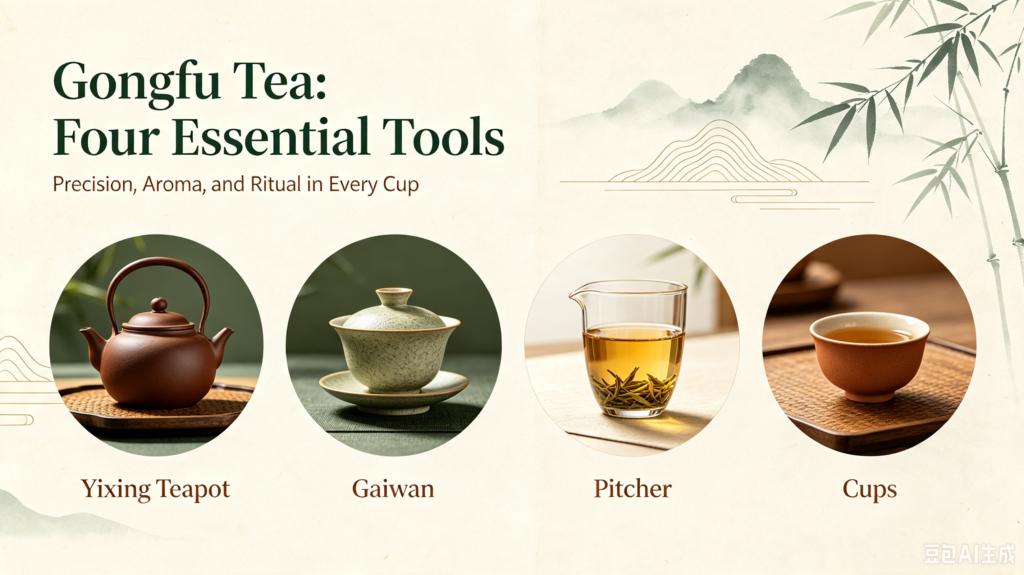
The Four Treasures of Gongfu Cha
| Tool | Chinese | Purpose and Notes |
| Yixing Clay Teapot | 紫砂壶 Zisha Hu | Made from Yixing purple clay (Jiangsu). Porous clay absorbs tea oils over years of use — a well-seasoned pot makes better tea. Antique Yixing pots by famous makers sell for millions. Good functional pots from ¥50 to ¥50,000+. |
| Gaiwan | 盖碗 | A lidded bowl used as both brewing vessel and drinking cup. More versatile than a teapot — the lid controls steeping time. Easier to clean than a clay pot. Standard in tea houses. |
| Tea Pitcher (Fairness Cup) | 公道杯 Gongdao Bei | After brewing, tea is poured into this pitcher to equalize concentration before distributing to individual cups. Ensures every cup tastes the same. The name means ‘fairness cup’. |
| Tea Cups | 品茗杯 | Small, handle-free cups holding 30 to 50ml. The small size is intentional — tea is sipped slowly, and each cup should be finished while still warm. Some sets include tall ‘smelling cups’ to appreciate aroma first. |
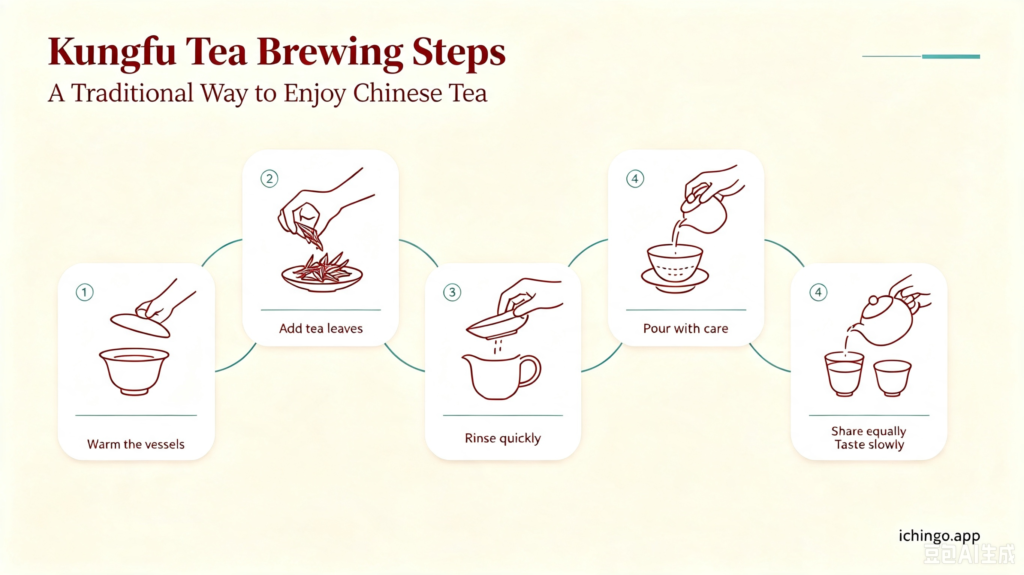
1.Warm the vessels — Pour hot water over the teapot and cups before brewing. This removes any dust and pre-warms everything so the brewing temperature stays stable.
2.Add tea leaves — Fill the teapot or gaiwan about 30 to 40 percent full with dry leaves. This is far more tea than Western brewing uses.
3.The rinse pour (wake the tea) — Pour hot water over the leaves, swirl briefly, and immediately discard. This opens the leaves, washes away any dust, and prepares them for the first real infusion.
4.First infusion — Pour water at the correct temperature (see chart below). Steep for 15 to 30 seconds only — much shorter than Western brewing. Pour immediately into the fairness cup.
5 Pour equally — From the fairness cup, fill all guest cups simultaneously. This ensures identical flavor for everyone at the table.
6.Repeat — Each subsequent infusion can be slightly longer (add 5 to 10 seconds per brew). Good oolongs and pu-erhs can be brewed 8 to 12 times, each revealing different flavor layers.
7.The tea table (茶盘) — All excess water and discarded rinses drain into the tea table — a bamboo or wooden tray with a drainage channel. This keeps the ceremony clean and meditative.
Water Temperature Guide
| Tea Type | Water Temperature | Why |
| Green Tea | 70–80°C (158–176°F) | High heat destroys green tea’s delicate catechins and produces bitterness. Never use boiling water. |
| White Tea | 75–85°C (167–185°F) | Gentle heat preserves the subtle sweetness. Aged white tea can handle slightly hotter water. |
| Yellow Tea | 75–85°C (167–185°F) | Treat like green tea. Very rare — you may not find it outside Hunan and Sichuan. |
| Oolong Tea | 85–95°C (185–203°F) | Lightly oxidized oolongs prefer lower heat; heavily roasted oolongs need near-boiling water. |
| Black Tea | 90–95°C (194–203°F) | Full oxidation means the leaves can handle high heat without excessive bitterness. |
| Pu-erh | 95–100°C (203–212°F) | Always use fully boiling water. The high heat opens the compressed fermented leaves properly. |
| 💡 Visitor Tip: When someone in a Chinese tea house taps two fingers lightly on the table after you pour their tea, they are saying ‘thank you’ — it is a gesture that originated in the Qing Dynasty when Emperor Qianlong traveled in disguise and poured tea for his companions. Not wanting to reveal his identity, his companions tapped two bent fingers on the table to secretly ‘bow’. The gesture survives today as a subtle sign of gratitude. |
Part 3 — Tea House Culture (茶馆 Chaguan)
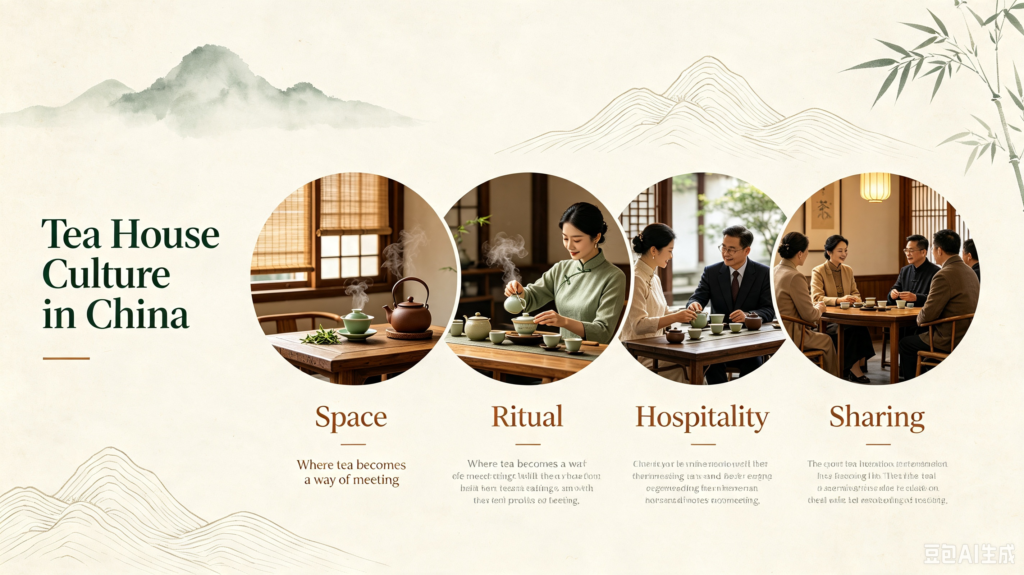
The Chinese tea house is one of the great inventions of urban life. Unlike the speed of a coffee shop, a tea house is designed for lingering — for conversation, business negotiations, storytelling, music, chess, and simply doing nothing for an hour or three. In Chengdu especially, tea houses are the social heart of the city.
Tea House Culture by City
| City | Tea House Style | What to Expect |
| Chengdu | Sichuan-style (川茶馆) | The most famous tea house city in China. Open-air tea houses in parks and temple courtyards. Bamboo chairs, ear-cleaning services, Sichuan opera face-changing shows. Gaiwan tea ¥10–¥30. Stay all day — no one will rush you out. |
| Hangzhou | Longjing (龙井茶馆) | Serene lakeside tea houses near West Lake. Order fresh Longjing — you may be seated next to the fields where it was picked that morning. Premium but worth it: ¥50–¥200/person. |
| Fujian | Gongfu tea shops (功夫茶) | The birthplace of Gongfu Cha. Tea shop owners in Anxi and Wuyi may spend an entire afternoon letting you taste dozens of oolongs. Buying is optional; the hospitality is genuine. |
| Yunnan | Pu-erh tea shops (普洱茶) | Yunnan tea shops function more like wine shops — serious collectors come to taste aged cakes and discuss vintage years. Fascinating even if you are just browsing. |
| Shanghai/Beijing | Designer tea houses (新式茶馆) | Modern tea houses that combine traditional ceremony with contemporary design. Popular with younger urban Chinese. Some offer tea cocktails and tea-pairing menus. Price: ¥80–¥300/person. |
| Nationwide | Old-style city tea houses | Found in every Chinese city near temple areas and old districts. Traditional atmosphere, local snacks, games of chess or mahjong. Usually ¥15–¥40/pot. |
| 📱 ichingo.app — China App Connection: Finding and booking tea houses in China:大众点评 (Dianping) — China’s Yelp. Search 茶馆 or 茶室 near your location for rated tea houses with photos, prices, and reviews. Most tea houses are on Dianping. Full guide on ichingo.app.美团 (Meituan) — Some tea houses offer reservation and coupon booking through Meituan. Also use Meituan for food delivery to pair with your tea session. Full guide on ichingo.app.小红书 (RedNote/Xiaohongshu) — The best platform for discovering hidden or trending tea houses. Search your city plus 茶馆 for photo-heavy recommendations from locals. Many posts are in Chinese but the photos tell the story.Klook — For guided tea ceremony experiences bookable in English with international card payment. Search ‘tea ceremony China’ for curated options in major cities. Full guide on ichingo.app. |
Part 4 — China’s Great Tea Regions
China’s tea geography is as complex and fascinating as its wine regions. Climate, altitude, soil, and processing tradition combine to produce teas with completely distinct identities. These are the regions worth knowing:
| Region | Famous Teas | Why It Matters |
| Zhejiang Province | Longjing, Anji Bai Cha | Home of China’s most famous green tea. The West Lake (Xihu) area around Hangzhou produces the highest-grade Longjing — picked only in early spring. Visit the tea fields in March or April. |
| Fujian Province | Tie Guan Yin, Da Hong Pao, Silver Needle, Lapsang Souchong | The most diverse tea province. Anxi produces oolong; Wuyi Mountains produce roasted oolongs and Lapsang Souchong; Fuding produces white tea. A tea lover’s paradise. |
| Yunnan Province | Pu-erh, Dian Hong (Yunnan black tea) | Ancient tea trees up to 1,000 years old grow in Xishuangbanna and the mountains near Simao. The original home of Camellia sinensis. Some old-tree Pu-erh cakes appreciate in value like fine wine. |
| Anhui Province | Keemun (Qimen), Huangshan Mao Feng | Huangshan (Yellow Mountain) produces some of China’s finest green teas. Keemun — China’s great black tea — comes from Qimen county in this province. |
| Hunan Province | Junshan Yinzhen (Yellow Tea), Anhua Dark Tea | Home of rare yellow tea and aged dark teas. Less visited by tourists but deeply important in Chinese tea history. |
| Guangdong Province | Dancong Oolong, Phoenix Tea | The Phoenix Mountains (Fenghuang) produce some of the most complex single-tree oolongs in China, each bush producing a unique flavor profile — honey, almond, ginger flower. |
| 📱 ichingo.app — China App Connection: Visiting China’s tea regions: Feizhu (飞猪) — Book high-speed train tickets to Hangzhou (Longjing), Fuzhou (Tie Guan Yin), or Kunming (Pu-erh). Full guide on ichingo.app. Baidu Maps (百度地图) — Navigate to tea plantations and markets in any city. Search 茶园 (tea garden) or 茶叶市场 (tea market) for nearby options. Full guide on ichingo.app. Klook — Guided tea plantation tours in Hangzhou (West Lake Longjing) and Wuyi Mountains. English-language, bookable with international cards. Didi (滴滴) — Get a private car to remote tea garden areas that are not served by public transport. Full guide on ichingo.app. |
Part 5 — Tea Etiquette & What to Know as a Visitor
5A. Essential Tea Etiquette
| ✅ DOTap two fingers on the table when someone pours your tea — this says ‘thank you’Hold the cup with both hands when receiving tea from a host — it shows respectWait for the host or the eldest person to drink first before you sipAccept at least one refill even if you are not thirsty — refusing can seem rudeAdmire the teapot or tea set — commenting on it is a genuine complimentPour for others before you pour for yourself | ❌ DON’TFill your own cup before your guests’ cups are fullPlace the teapot with the spout pointing at anyone — it is considered aggressive or rudeTap the table with all five fingers — only two fingers (index and middle) for the gratitude gestureLeave the lid of the gaiwan or teapot upside down — this signals you want more hot water, not that you are doneDrink the tea down to the last drop in one go — Gongfu Cha is for slow, multiple sipsIgnore a refill being offered — acknowledge it with the two-finger tap even if you cover your cup |
5B. What to Say — Useful Phrases
| English | Chinese | Pronunciation |
| This tea is delicious | 这茶很好喝 | Zhe cha hen hao he |
| What kind of tea is this? | 这是什么茶? | Zhe shi shenme cha? |
| Can I have some more? | 可以再来一杯吗? | Keyi zai lai yi bei ma? |
| I would like to try Longjing | 我想试试龙井 | Wo xiang shishi Longjing |
| How much per pot? | 一壶多少钱? | Yi hu duoshao qian? |
| The teapot is beautiful | 这茶壶很漂亮 | Zhe chahu hen piaoliang |
| Do you have pu-erh? | 有没有普洱茶? | You meiyou Pu’er cha? |
| Thank you (tea tap gesture) | (two-finger tap on table) | — |
5C. Buying Tea — What to Know
- China’s tea markets (茶叶市场) are overwhelming — dozens of vendors, hundreds of teas, and almost no English. Arrive knowing what you want to try.
- Sampling is expected and free. A good vendor will brew multiple teas for you before any purchase. Never feel obligated to buy after tasting.
- Prices vary enormously — the same tea name can cost ¥20 or ¥20,000 per 100g. Quality differences are real but require experience to detect.
- Safe starting prices: good everyday green tea ¥50–¥200/100g; good oolong ¥100–¥500/100g; good white tea ¥80–¥300/100g.
- Vacuum-sealed, factory-packaged tea is safer for international travel than loose leaf in bags.
- The best tea gifts: small vacuum-packed Longjing tins, individual Pu-erh mini-cakes, or a simple gaiwan set.
| 📱 ichingo.app — China App Connection: Buying tea in China with app support: Alipay / WeChat Pay — Tea markets are cash-light. Set up Alipay with your international card before visiting any tea market. Full setup guide on ichingo.app. Yandex Translate — Point your camera at tea packaging labels to translate ingredients, origin, harvest date, and grade. No VPN needed inside China. Full guide on ichingo.app. Taobao / JD.com — For buying tea online with delivery to your hotel or airbnb. JD.com carries certified genuine teas from major brands. Taobao has the widest selection. Both guides on ichingo.app. 大众点评 (Dianping) — Search 茶叶市场 for the nearest major tea market in any Chinese city, with opening hours and user reviews. |
Part 6 — Visitor Quick Reference
The Complete ichingo.app Toolkit for Tea Culture
| Need | App | How It Helps |
| Find a tea house | Dianping (大众点评) | Search 茶馆 or 茶室 in any city. Ratings, photos, prices, hours. China’s most reliable local review platform. |
| Book a tea ceremony experience | Klook | English-language guided tea ceremonies bookable in advance. Accepts Visa/Mastercard. Available in Beijing, Shanghai, Hangzhou, Chengdu. |
| Navigate to tea gardens or markets | Baidu Maps | Search 茶园 (tea garden) or 茶叶市场 (tea market). English interface for major destinations. |
| Get to tea regions | Feizhu / Trip.com | High-speed train tickets to Hangzhou, Fuzhou, Kunming, or any tea-producing city. Full guides on ichingo.app. |
| Translate tea packaging | Yandex Translate | Camera translation of Chinese text — packaging labels, menus, signs. No VPN needed. |
| Pay at tea markets | Alipay / WeChat Pay | Tea markets are almost cashless. Set up before you go. International card setup guides on ichingo.app. |
| Buy tea online | JD.com / Taobao | JD for certified branded teas; Taobao for wider selection. Both deliver to hotels. Guides on ichingo.app. |
| Discover trending tea spots | Xiaohongshu (RedNote) | China’s best platform for visual tea house discoveries. Search city name plus 茶馆. |
Final Thought
There is a Chinese saying: ‘The first cup of tea wakes you up. The second cup makes you think. The third cup makes you forget the world.’ Gongfu Cha is not about getting caffeine into your body as efficiently as possible. It is about having a reason to sit with another person, give them your full attention, and share something beautiful for an hour.
In a country of 1.4 billion people moving at extraordinary speed, that is a radical act. And it has been practiced here, in roughly the same form, for 5,000 years.
For step-by-step guides to every app mentioned in this document — Dianping, Klook, Baidu Maps, Feizhu, Yandex Translate, Alipay, JD.com, Taobao, and more — visit ichingo.app — your complete toolkit for experiencing China.


2 Responses
Very good information about tea. Could you explain why, in Chinese and some other languages, tea is called “cha” or “chai,” while in English and some other languages it is called “tea”?
Great question! It actually comes down to historical trade routes. Countries that got tea overland from northern/western China usually call it ‘cha’ or ‘chai’. Meanwhile, those who got it via the sea routes from the southern Fujian coast adopted the local pronunciation ‘te’, which became ‘tea’. It’s basically a linguistic map of global trade! 🗺️🍵