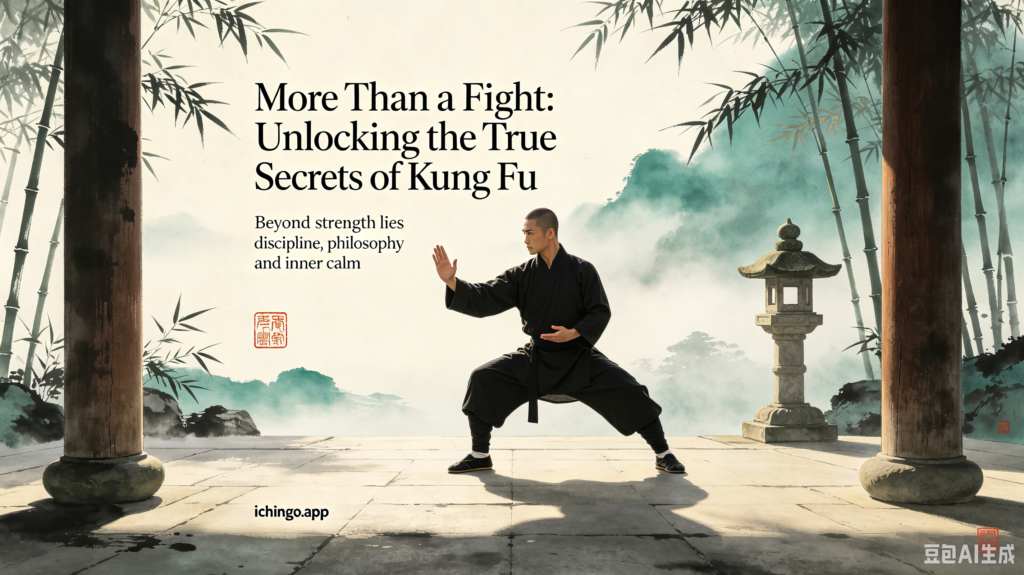
More Than a Fight: Unlocking the True Secrets of Kung Fu
History, styles, philosophy & where to experience it — for first-time visitors to China
Introduction — More Than Movie Kicks
When most foreigners think of Chinese kung fu, they picture Bruce Lee, Jackie Chan, or flying monks from a movie. The reality is far more interesting. Chinese kung fu — practiced for over 3,000 years — is simultaneously a fighting system, a physical art form, a spiritual practice, a medical therapy, and a philosophy of life. It is one of China’s most important cultural exports, and one of the most accessible parts of Chinese culture for visitors to experience firsthand.
This guide covers what kung fu actually is, the major styles and their differences, where to watch and learn kung fu as a visitor, and which apps on ichingo.app will help you book tickets, find classes, navigate to temples, and translate what the master is telling you.
Part 1 — What Is Kung Fu? (功夫 Gongfu)
The Word Itself
Kung Fu (功夫) does not literally mean martial arts in Chinese. The word means skill achieved through hard work and time — it refers to any mastery developed through long, dedicated practice. A chef who has perfected dumplings after 20 years has kung fu. A calligrapher with flawless brushwork has kung fu. A warrior with devastating fighting technique has kung fu.
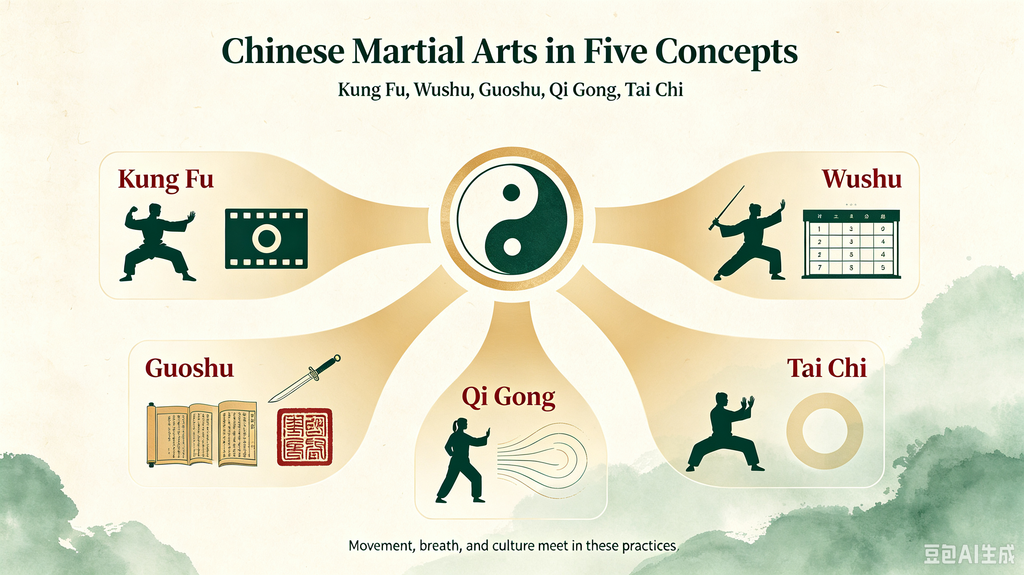
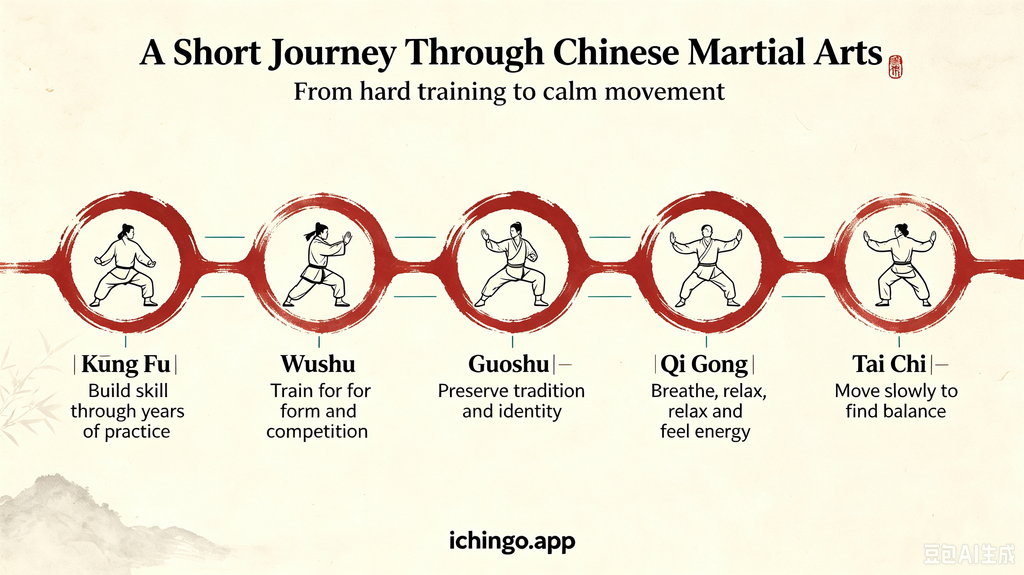
Term
Chinese
Meaning
Kung Fu
功夫 Gongfu
Skill through hard work — any mastery
Wushu
武术 Wushu
Martial arts — modern competition sport
Guoshu
国术 Guoshu
National art — traditional forms and identity
Qi Gong
气功 Qigong
Energy cultivation — breathing and meditation
Tai Chi
太极拳 Taijiquan
Internal style — slow, meditative movement
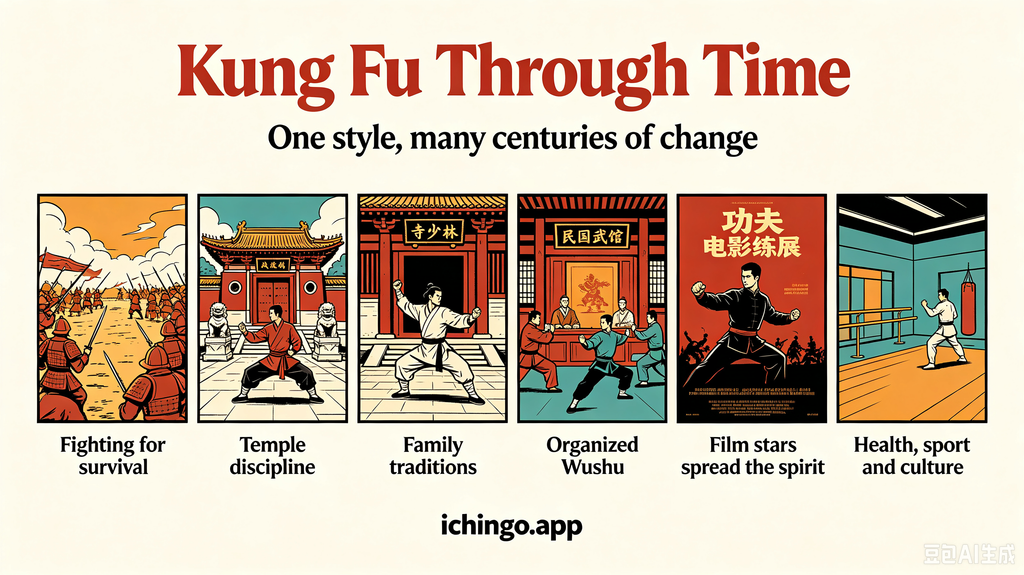
A 3,000-Year History in 5 Lines
Origins: Combat skills developed for hunting and warfare, documented from the Shang and Zhou Dynasties (17th to 3rd century BC)
Shaolin: The Shaolin Temple built in 495 AD in Henan became the cradle of Chinese martial arts, blending Buddhism, Taoism, and combat
Golden Age: Song to Ming Dynasties (960 to 1644 AD) — hundreds of distinct schools, boxing styles, and weapon systems flourished
Modern era: Republican China standardized kung fu for national identity; the Communist era formalized Wushu as a competitive sport
Today: Both traditional kung fu and modern competitive wushu exist side by side — one preserves lineage and philosophy, one emphasizes athletic performance
📌 Did You Know: The legendary Bodhidharma, the Indian monk credited with founding Chan (Zen) Buddhism in China, is said to have taught Shaolin monks physical training that became the foundation of Shaolin Kung Fu. Whether historically accurate or not, this story has shaped kung fu mythology for 1,500 years.
Part 2 — The Major Styles of Kung Fu
Chinese martial arts divide into two broad families: External styles (外家拳) emphasize physical strength, speed, and technique. Internal styles (内家拳) emphasize Qi (energy), breath, mental focus, and using an opponent’s force against them.
Style
Chinese
Type
Origin
What Makes It Unique
Shaolin Kung Fu
少林功夫
External
Shaolin Temple, Henan, 5th c. AD
The most famous style. Power, speed, acrobatics. 72 arts including iron body training. Basis of countless other styles.
Tai Chi
太极拳
Internal
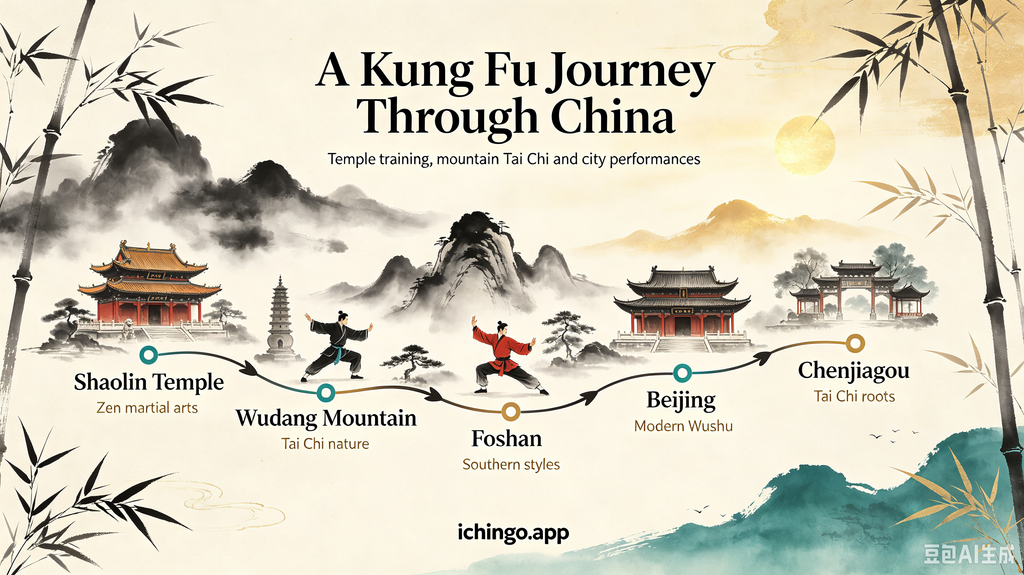
Chen Village, Henan, 17th c.
Slow, fluid, meditative movements that cultivate Qi and balance. Practiced by over 300 million people worldwide. Excellent for health at any age.
Wing Chun
咏春拳
External
Guangdong, Qing Dynasty
Close-range, fast strikes. Economy of movement. Legendarily developed by a woman. Made famous globally by Bruce Lee and Ip Man.
Bagua Zhang
八卦掌
Internal
Beijing, 19th century
Circular walking patterns based on the Eight Trigrams. Evasive, spinning movements. One of the Big Three internal styles.
Xing Yi Quan
形意拳
Internal
Shanxi, 17th century
Linear, direct, explosive strikes. Movements based on 5 elements and 12 animals. Among the most combat-effective internal styles.
Wudang Kung Fu
武当功夫
Internal
Wudang Mountains, Hubei
The Taoist counterpart to Shaolin Buddhist kung fu. Emphasizes internal energy, sword techniques, and harmony with nature.
Northern Long Fist
长拳
External
Northern China
Wide stances, long-range kicks, acrobatic jumping. Foundation of modern competitive wushu.
Hung Gar
洪拳
External
Guangdong, Qing Dynasty
Strong horse stance, powerful arm techniques. One of the Five Animals southern styles.
💡 Visitor Tip: If you only try one thing in China related to kung fu, make it Tai Chi in a public park at dawn. In every major city, hundreds of people gather at sunrise to practice together — in temple gardens, lakeside parks, or plazas. It is free, open to all, and one of the most distinctly Chinese experiences available to any visitor.
Part 3 — The Philosophy of Kung Fu
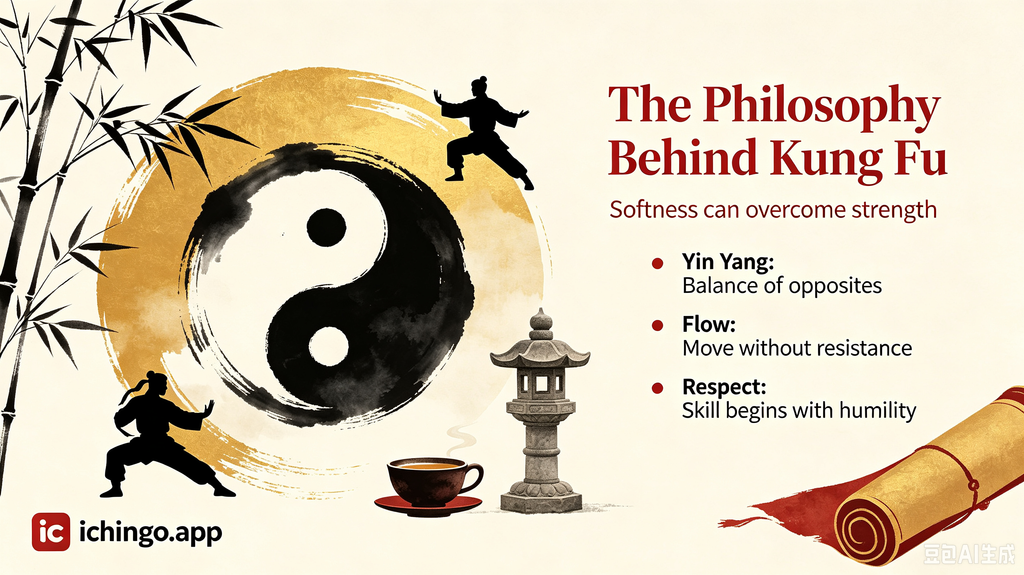
What separates Chinese kung fu from a mere fighting system is its philosophical depth. Every major style is built on a foundation of ethics, spirituality, and a philosophy of how to live — not just how to fight.
Pillar
What It Means in Kung Fu
De (德) — Virtue
Virtue, humility, and discipline come before technique. The most dangerous fighters are expected to be the most peaceful people.
Qi (气) — Life Energy
All internal styles cultivate Qi — the vital energy flowing through the body along meridians (same concept as Chinese medicine). Good kung fu is about generating and directing Qi efficiently, not just muscle power.
Tao (道) — The Way
Especially in Wudang and Tai Chi traditions, kung fu is a path of alignment with the natural world. The highest mastery is effortlessness — not forcing, but flowing.
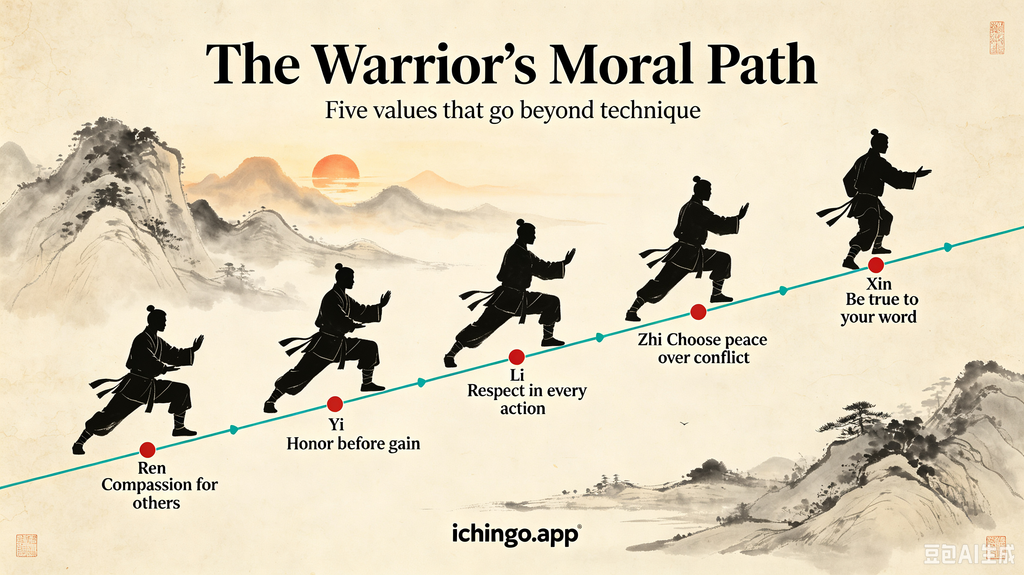
The Five Virtues of a Martial Artist
Ren (仁) — Benevolence: treat others with compassion, especially those weaker
Yi (义) — Righteousness: act with honor and moral principle, not self-interest
Li (礼) — Courtesy: respect your master, peers, and opponents
Zhi (智) — Wisdom: understand when to fight and when not to. The greatest warriors avoid unnecessary conflict
Xin (信) — Integrity: be honest in word and deed; keep your promises
📌 Did You Know: Bruce Lee’s famous quote — Be like water — is a direct expression of Taoist kung fu philosophy. Water is soft but overcomes hard rock. It takes the shape of any container but is unstoppable. This idea is central to Wing Chun, Tai Chi, and virtually all internal styles.
Part 4 — Where to Experience Kung Fu in China
4A. Watch a Professional Kung Fu Show
The fastest way to experience kung fu as a visitor is a professional stage performance. These shows combine martial arts, acrobatics, music, and storytelling into a 60 to 90 minute theatrical experience.
City
Venue
Show
Price and Notes
Beijing
Red Theatre (红剧场)
The Legend of Kung Fu
¥280–¥680/person. 70-min nightly. English subtitles above stage. The most famous kung fu show in China.
Beijing
Jinsong Theatre
Legend of Shaolin Kung Fu
¥280/person. 60-min. Book via Klook or Trip.com.
Dengfeng, Henan
Shaolin Temple Martial Arts Hall
Shaolin Monk Performance
FREE with temple ticket (¥100). Daily shows. The most authentic option.
Shanghai
ERA Intersection of Time
Acrobatics and Martial Arts
¥180–¥680. More acrobatics-focused but includes kung fu elements.
📱 ichingo.app — China App Connection: To book kung fu shows and Shaolin Temple tours:Klook — Search Kung Fu Show Beijing or Shaolin Temple Tour. English booking, instant confirmation, accepts Visa/Mastercard. Full guide on ichingo.app.Trip.com (携程) — More options and often cheaper than Klook for domestic venues. Full guide on ichingo.app.Feizhu (飞猪) — Best for combining Shaolin visits with high-speed train tickets from Zhengzhou or Luoyang. Full guide on ichingo.app.
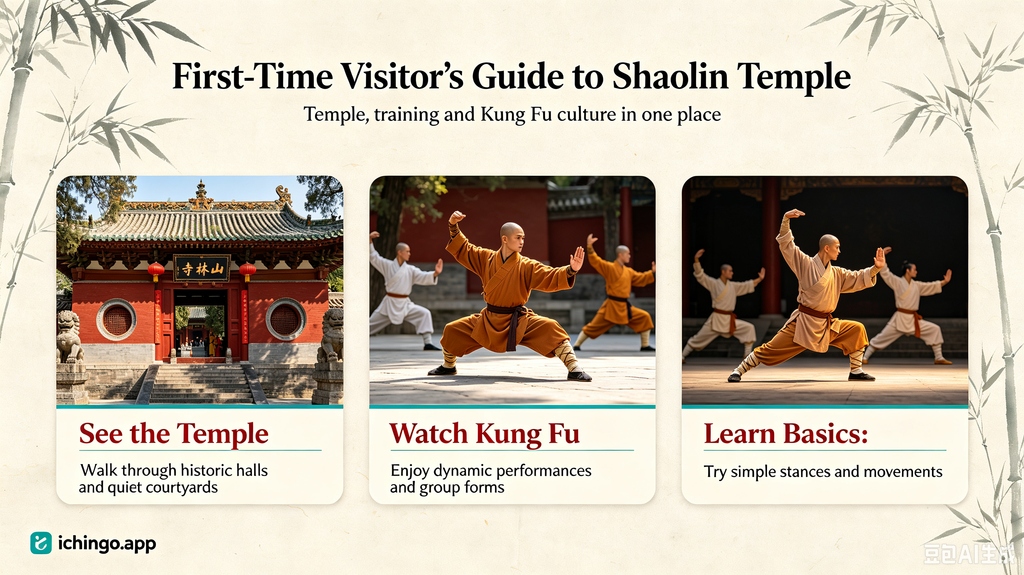
4B. Visit the Shaolin Temple (少林寺)
The Shaolin Temple in Dengfeng, Henan Province, is the single most important kung fu destination in China. Founded in 495 AD, it is the birthplace of Shaolin Kung Fu and Chan (Zen) Buddhism, and a UNESCO World Heritage Site since 2010.
Location: Mount Song, Dengfeng City, Henan Province — about 80km from Zhengzhou
Getting there: High-speed train to Zhengzhou, then bus or taxi to Dengfeng (about 1.5 hours)
Entrance fee: ¥100 per person — includes Pagoda Forest and Martial Arts Hall
Daily kung fu performances: Free with entry ticket at the Martial Arts Hall — check the daily schedule at the gate
Kung fu training classes: Short introductory sessions on-site; multi-day residential programs at nearby martial arts schools
📱 ichingo.app — China App Connection: Getting to Shaolin Temple as a foreigner:Baidu Maps (百度地图) — Navigate from Zhengzhou train station to Shaolin Temple. The English interface works well for major destinations. Full guide on ichingo.app.Didi (滴滴) — Book a private car from Zhengzhou to Dengfeng for about ¥150–¥200. Easier than the bus and works with a foreign phone number. Full guide on ichingo.app.Yandex Translate — When monks give instruction or you need to read temple signs, point your camera at any Chinese text for instant translation. No VPN needed inside China. Full guide on ichingo.app.
4C. Try a Kung Fu Class
Experience Type
Price Range
What to Expect
Drop-in trial class
¥100–¥200
1-hour intro at a local studio. Basic punches, stances, a short form. Often in English near tourist areas in Beijing and Shanghai.
Half-day experience
¥200–¥500
2 to 3 hours. Learn a short sequence, get a certificate. Available near major sites and martial arts schools.
Shaolin day class
¥300–¥800
On-site instruction at Shaolin Temple or nearby school. Covers horse stance, basic strikes, traditional conditioning.
1-week residential
¥3,000–¥8,000
Daily training 6 to 8 hours. Accommodation and meals included. Wudang Mountain and Shaolin area have the best programs.
1-month immersion
¥8,000–¥20,000
Full residential at a traditional school. Includes Chinese basics, meditation, Qi Gong, and intensive fighting practice.
4D. Watch Tai Chi at Dawn — Free, Anywhere
One of the most underrated experiences in China is completely free: watching or joining morning Tai Chi in a public park. This happens every morning in virtually every Chinese city, usually between 6am and 8am.
Beijing: Temple of Heaven park, Beihai Park, Jingshan Park
Shanghai: People’s Square, Century Park, Fuxing Park
Guangzhou: Yuexiu Park, Baiyun Mountain
Chengdu: Renmin Park, Wangjiang Tower Park
Xi’an: City Wall park, especially near the east gate
✅ Good to Know: Just stand at the edge and watch. Most practitioners are happy to let visitors observe. If you want to join, stand nearby and copy the movements. No one will ask you to leave. This is one of the most genuine cultural experiences available to any visitor in China — and it is free.
Part 5 — Kung Fu in Chinese Culture
5A. The Legendary Masters
Name
Era / Style
Significance
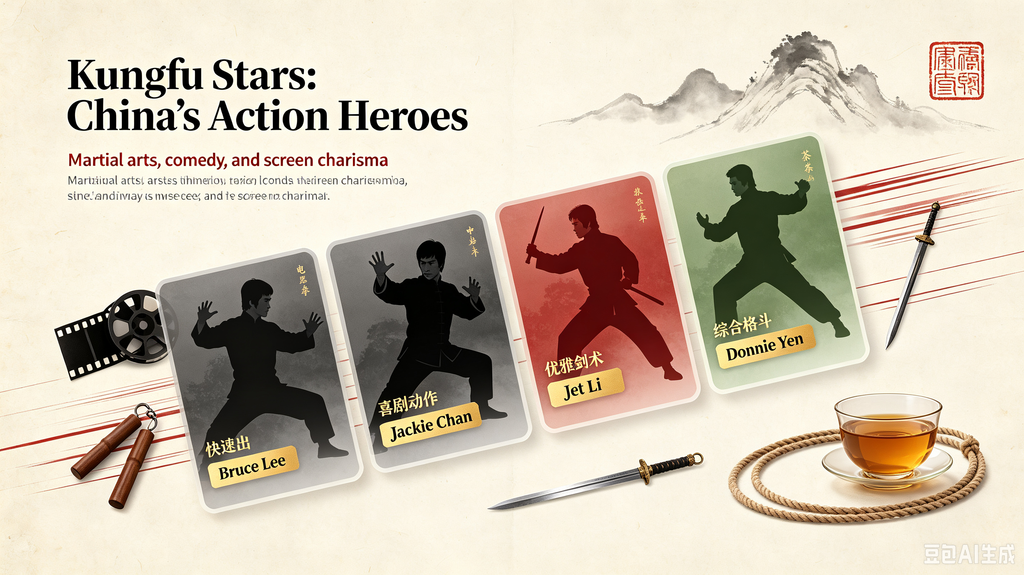
Bruce Lee (李小龙)
1960s–70s / Jeet Kune Do
The man who brought kung fu to the world. His philosophy — be like water — is pure Taoism. He created his own synthesis style, rejecting rigid forms.
Jackie Chan (成龙)
1980s–2000s / Various
Pioneered acrobatic kung fu comedy. His training at the China Drama Academy began at age 7 — 10 hours a day for 10 years.
Jet Li (李连杰)
1980s–2000s / Wushu
5-time Chinese national wushu champion before becoming an actor. His films Hero and Fearless are visually stunning explorations of kung fu philosophy.
Donnie Yen (甄子丹)
2000s–present / Wing Chun
The Ip Man film series made Wing Chun globally famous and sparked an international surge in Wing Chun school enrollment.
Ip Man (叶问)
Historical (1893–1972)
The real Wing Chun master who taught Bruce Lee in Hong Kong. His story is the subject of multiple major films.
5B. Kung Fu as Health Practice
In modern China, the vast majority of people who practice kung fu-related activities do so for health, stress relief, and community. Tai Chi and Qi Gong have large bodies of modern medical research supporting their benefits:
Tai Chi reduces falls in elderly patients — confirmed by multiple clinical trials
Regular Tai Chi practice reduces blood pressure and improves balance and flexibility
Qi Gong is prescribed alongside conventional medicine for some chronic conditions in Chinese hospitals
The meditative focus required in internal styles has measurable effects on stress reduction
📱 ichingo.app — China App Connection: Practicing kung fu and health exercises in China with app support:平安好医生 (Ping An Good Doctor) — Book TCM doctors who can prescribe Qi Gong or Tai Chi as part of a health plan. Works with foreign phone numbers. Guide on ichingo.app.Keep (Keep App) — China’s most popular fitness app with Tai Chi and Qi Gong video courses. Over 300 million users. A great way to learn basics before a live class.Weibo (微博) — Many kung fu masters run Weibo accounts with free training videos. Search 太极 or 少林功夫 to find them. Weibo guide on ichingo.app.
Part 6 — Visitor Quick Reference
Useful Chinese Phrases
English
Chinese
Pronunciation
Where can I watch kung fu?
哪里可以看功夫?
Nali keyi kan gongfu?
I want to try a kung fu class
我想体验功夫课
Wo xiang tiyan gongfu ke
How much is the ticket?
票多少钱?
Piao duoshao qian?
Is there an English guide?
有英文导览吗?
You Yingwen daolan ma?
What time does it start?
几点开始?
Ji dian kaishi?
Shaolin Temple
少林寺
Shaolin Si
Tai Chi
太极拳
Taijiquan
Can I join the practice?
我可以加入吗?
Wo keyi jiaru ma?
The Complete ichingo.app Toolkit for Kung Fu Visitors
Need
App
How It Helps
Book show tickets
Klook / Trip.com
English booking for Beijing Red Theatre and Shaolin Temple tours. Accepts international cards. Full guide on ichingo.app.
Get to Shaolin Temple
Didi + Feizhu
Didi for local taxi; Feizhu for high-speed train to Zhengzhou. Both guides on ichingo.app.
Navigate to parks for Tai Chi
Baidu Maps
English interface for major parks. Search park name for walking or transit directions.
Translate the instructor
Yandex Translate
Point camera at Chinese text for instant translation. No VPN needed inside China.
Find martial arts classes nearby
Dianping
Search 武馆 (martial arts school) near your location for classes and reviews.
Book restaurants after practice
Meituan
Food delivery or restaurant reservations near any venue. Guide on ichingo.app.
Buy train tickets to Henan
Feizhu / Trip.com
Book high-speed rail to Zhengzhou — the nearest major hub to Shaolin Temple.
Pay for everything
Alipay / WeChat Pay
Temple entry, show tickets, taxis — all accept QR code payment. Setup guides on ichingo.app.
Final Thoughts
Chinese kung fu is one of humanity’s great living traditions. It connects a fisherman’s grandson who practices Wing Chun in Hong Kong with a Shaolin monk who learned the same lineage 1,500 years ago. It turns physical movement into philosophy, self-defense into meditation, and a fighting art into a path of personal cultivation.
Whether you watch a monk break a spear shaft against his throat at the Shaolin Temple, join a hundred people for Tai Chi in a Shanghai park at sunrise, or sit down for a 90-minute performance at Beijing’s Red Theatre — kung fu is one of the most visceral and memorable ways to connect with Chinese culture.
For step-by-step guides to every app mentioned in this document — Klook, Didi, Feizhu, Baidu Maps, Yandex Translate, Dianping, Alipay, Meituan, and more — visit ichingo.app — your complete toolkit for experiencing China.